
1 / 8The view to Kudaka島が見える岩壁
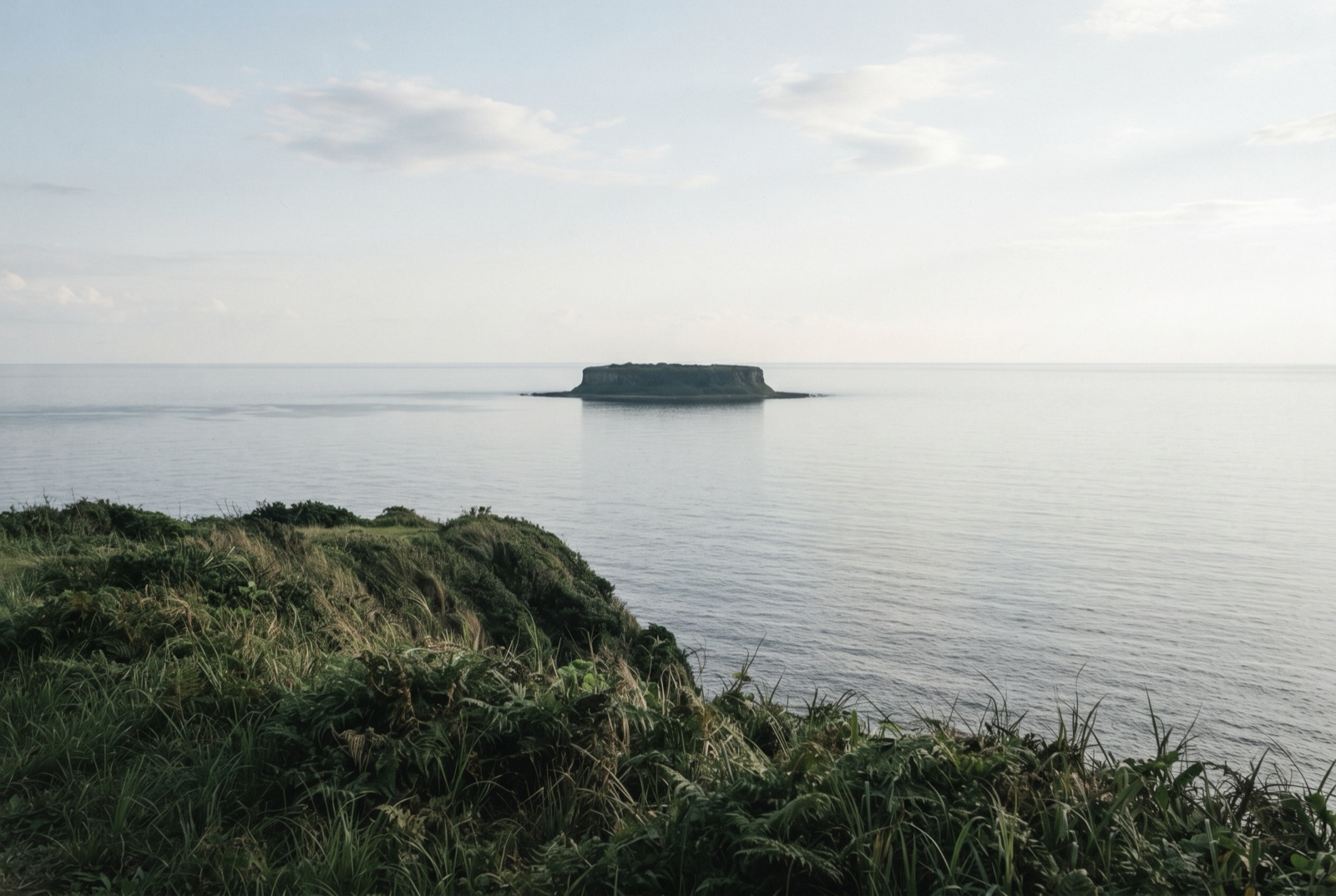
Near the back of Sefa-utaki, there is a gap in the rock wall.
Through it, you can see a flat island out at sea.
That island is Kudaka.
And a stone censer is placed there.
From the break in the rock wall to the left of Chōnuhana, Kudaka Island can be seen. A cut-stone censer is placed here as well.Utaki of Nanjo City (Nanjo City Board of Education, 2018), pp. 108–109 (our translation)
A censer means this is not a viewpoint. It is a place to pray.
People stood here and worshipped the island, without going to it.
2 / 8The shore of Kudaka島の浜も、拝む場所
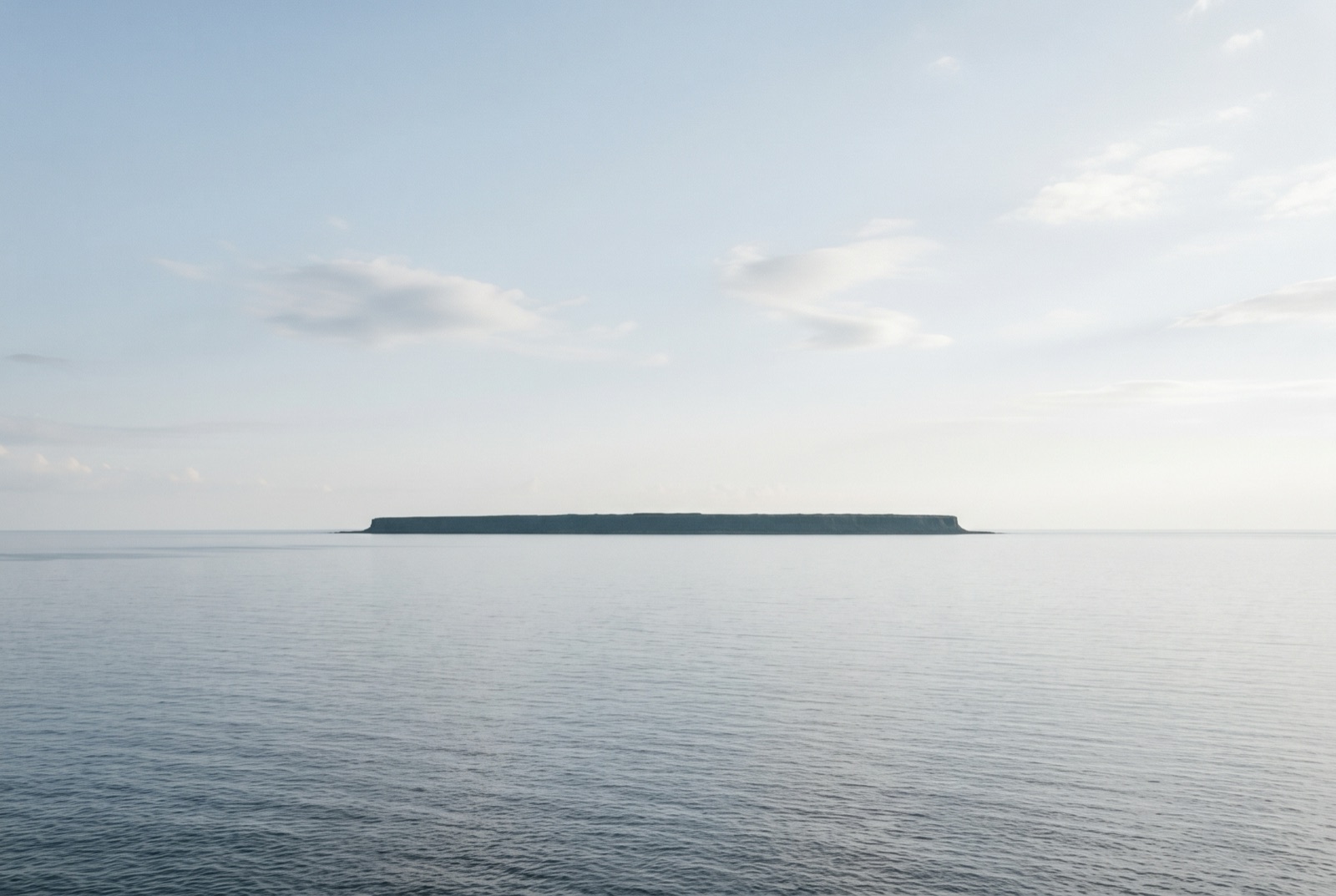
On Kudaka there is a beach called Ishiki-hama.
That beach was a place of worship too.
Ishiki-hama has the character of a place of distant worship toward Girai-Kanai.Utaki of Nanjo City (Nanjo City Board of Education, 2018), p. 132 (our translation)
From Sefa-utaki, people pray toward Kudaka. From a beach on Kudaka, they pray farther still.
The direction of prayer moves east, and then east again.
3 / 8The sea to the east東の海の向こう
So what lies beyond?
Girai-Kanai corresponds to the word Nirāhanā on present-day Kudaka. It is the world of the gods, out on the eastern sea.Utaki of Nanjo City (Nanjo City Board of Education, 2018), p. 132 (our translation)
Nirai-Kanai: in Okinawan rituals, an otherworld said to lie beyond the sea, or beneath the sea or the ground.Utaki of Nanjo City (Nanjo City Board of Education, 2018), glossary no. 89, p. 470 (our translation)
Beyond the sea. No one can go there.
4 / 8What washed ashore流れ着いた壺
From a place no one can reach, something once drifted in.
The beach is said to be where a white jar containing the seeds of the five grains washed ashore. The old records differ on the contents: one lists seven kinds of seed, the other three kinds of barley, three of millet, and one bean.Utaki of Nanjo City (Nanjo City Board of Education, 2018), p. 132 (our translation)
Food.
Behind the myth of the five grains washing up at Ishiki-hama, we can see the idea that the five grains were a gift from Nirai-Kanai.Utaki of Nanjo City (Nanjo City Board of Education, 2018), p. 132 (our translation)
For the people of this land, food was a gift from across the sea.
That is why they pray at that beach.
5 / 8The order of the pilgrimage巡拝の順番
Some people still walk it in that order.
The fact that people make the pilgrimage to Upuragā, Yagurugā spring, Hatasu, and Ishiki-hama can be seen as based on this myth of the origin of grain.Utaki of Nanjo City (Nanjo City Board of Education, 2018), p. 131 (our translation)
- ①Upuragā
- ②Yagurugāwhere people purified themselves before picking up the jar (p. 133)
- ③Hatasu
- ④Ishiki-hamathe beach where the jar washed ashore
Wash first. Then receive.
They still retrace, in the same order, what happened in the myth.
6 / 8Places we do not enter入れない場所
And some places are still closed today.
On Kudaka, Fubō-utaki is closed all year round. Some other places are closed at certain times of the year.
The only beach where swimming is allowed is Mēgi-hama. The others are objects of worship.
Kudaka Island official guidance, "Rules on the Island"
7 / 8Over 1,100 utaki and places of prayer1,100以上の御嶽と拝所
Nanjo City has more than 1,100 utaki and places of prayer.
In the survey carried out for this book, more than 1,100 utaki and places of prayer were confirmed within Nanjo City.Utaki of Nanjo City (Nanjo City Board of Education, 2018), p. 2 (message from the Mayor; our translation)
Eleven hundred.
Praying was never something special here.
8 / 8Back at the cliffもう一度、あの岩壁へ
Go back to that gap in the rock wall at Sefa-utaki.
Standing there, nothing happens. You see the sea, and an island.
But once you know why the censer is there, the same view looks different.
A photograph cannot do that.
3Why it takes three daysWHY IT TAKES THREE DAYS
We are not going to talk you into staying longer. Just count it out.
| Crossing to Kudaka | The ferry needs a round trip and does not run often. That takes a whole day. |
| Where to sleep | There are few places to stay on Kudaka, and almost nowhere open for dinner. So you stay on the main island. |
| The rest | Sefa-utaki and the four utaki pilgrimage, on other days. |
Two nights. You worked that out yourself. The day-by-day plan is on the route page (JA) (Japanese).
BeforeBefore you goBEFORE YOU GO
Utaki (御嶽) is a sacred site: a holy place, a place of worship. It is not a shrine. There is no gate, no hall, no statue. We keep the word utaki and do not translate it.
Utoushi (遥拝) means praying from a distance.
Please don't call it a "power spot." Nanjo City has formally asked that the term not be used. These are places of worship that are still in use, not attractions.
- Shoes: the paths are not paved. Comfortable walking shoes are recommended.
- Socks: this is sacred ground, so please wear socks.
- Clothing: please avoid tank tops. A short-sleeved collared shirt is preferred.
- Sanguui, the innermost triangular passage at Sefa-utaki, is currently closed to entry.
Details are being prepared.
This page is a work in progress. If something here is unclear or wrong, please tell us: [email protected]